


Hollywood: The Strategic Analysis
At the end, and beginning, of an era

One cool thing:
http://ddocs.new is like google docs except decentralized and encrypted end to end. You can sign in with an email or a crypto wallet.
Have you noticed a feeling of a changing of the guard, by the way?
There was something about the Biden Hollywood fundraiser in LA (and the Aspen ideas institute) with oh I won’t name anyone but with a lot of pictures of people and a lot of quotes. And what it made me think was that we have had the same people in charge, more or less, since the end of the 80s. I thought as I looked at the pictures and read the quotes — wow, this is truly the last hurrah. Anyone who can be relevant for 40 years must be amazing. But … all good things come to an end.
What should everyone do from here?
Who is going to thrive and who isn’t? And a key question for everyone is this: as traditional revenue streams continue to shrink, can Hollywood find a way to recreate the economic success of its peak DVD and cable era, or are we witnessing the permanent downsizing of the entertainment industry as we know it? Can video on demand (both subscription and ad-supported) deliver a prosperous future? And if so, how widely will those riches be distributed?
Before we look at individual companies, a few things that matter to everyone across the industry —
Brand matters. With a subscription product, people want to know what they have to look forward to. Few video services have made much progress on their brand. Disney and Netflix are exceptions.
Every business is a tech business. Technology matters to everyone. It should be easy to know who a company’s technical leader is.
Prioritize the business that matters. Not all divisions are equally important. In Hollywood today, we see three types of businesses: broadcast/cable assets that generate cash but are shrinking; movie studios that produce some cash but have limited growth potential; and streaming services, which are the potential stars of tomorrow. The industry's focus should be on nurturing these streaming services. This means all content should ultimately serve the streaming platform. Organizationally, content leaders should report to the head of streaming, not the CEO, ensuring the service has visibility into all development company-wide. The streaming service is what matters most for future growth.
New fashioned leaders. It’s the end of an era indeed. And it’s the start of a new one. I wrote about who should be running Hollywood. The new fashioned leaders will be people who get tech and creative. The old fashioned leaders are basically finance, sales and business affairs people. I think Bezos, Bill Gates, Larry Page, Satya Nadella and others in tech have demonstrated that product leadership is the almost important thing and you can always find people to help with the business details. In the new world, companies have to embrace a new model for a modern major general. David Ellison is a good example of this.
Put the best players on the field. Discussed here. We really don’t have the luxury to be running out the JV every week. No one can afford that.
Were windows a one way door? Hollywood's cash flow issues stem at least partly from the shift from multiple revenue windows (theatrical, DVD, rental, pay one, free TV, foreign) to essentially two: theatrical (sometimes) and streaming. The robust theatrical and DVD windows once captured significant value that the all-you-can-eat subscription model now forgoes. Cable TV, another former cash cow, has been crushed by the focus on on-demand content. When DVD and cable were strong, Hollywood thrived. Is it possible to restore value to ownership? Or even cable? This question deserves serious investigation.
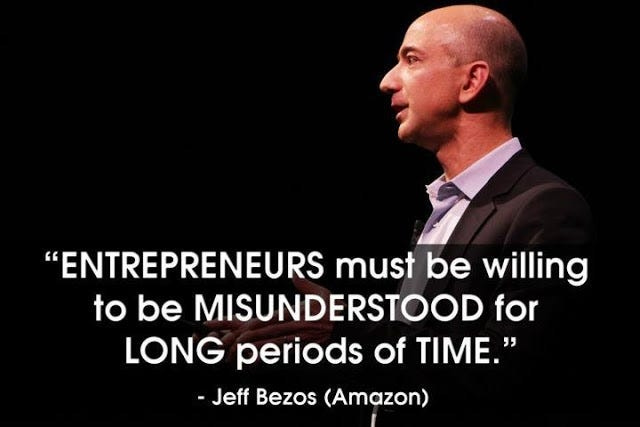
Don’t stop the car if you’re not home yet. Almost everyone in Hollywood has looked at the high interest rates and the consequent indifference of the market to 2029 cash flows and decided that they need to produce big cash flows now at every division. I get the reasoning but that is a bad idea if it is still time to invest in growth (and you’re not delivering “big” cash flows in any case). Netflix invested in growth and now they have robust cash flows. Amazon invested in growth for a long time and this is a good Bezos quote to remember —

Don’t stop investing in the business if it needs it.
Warner Bros Discovery
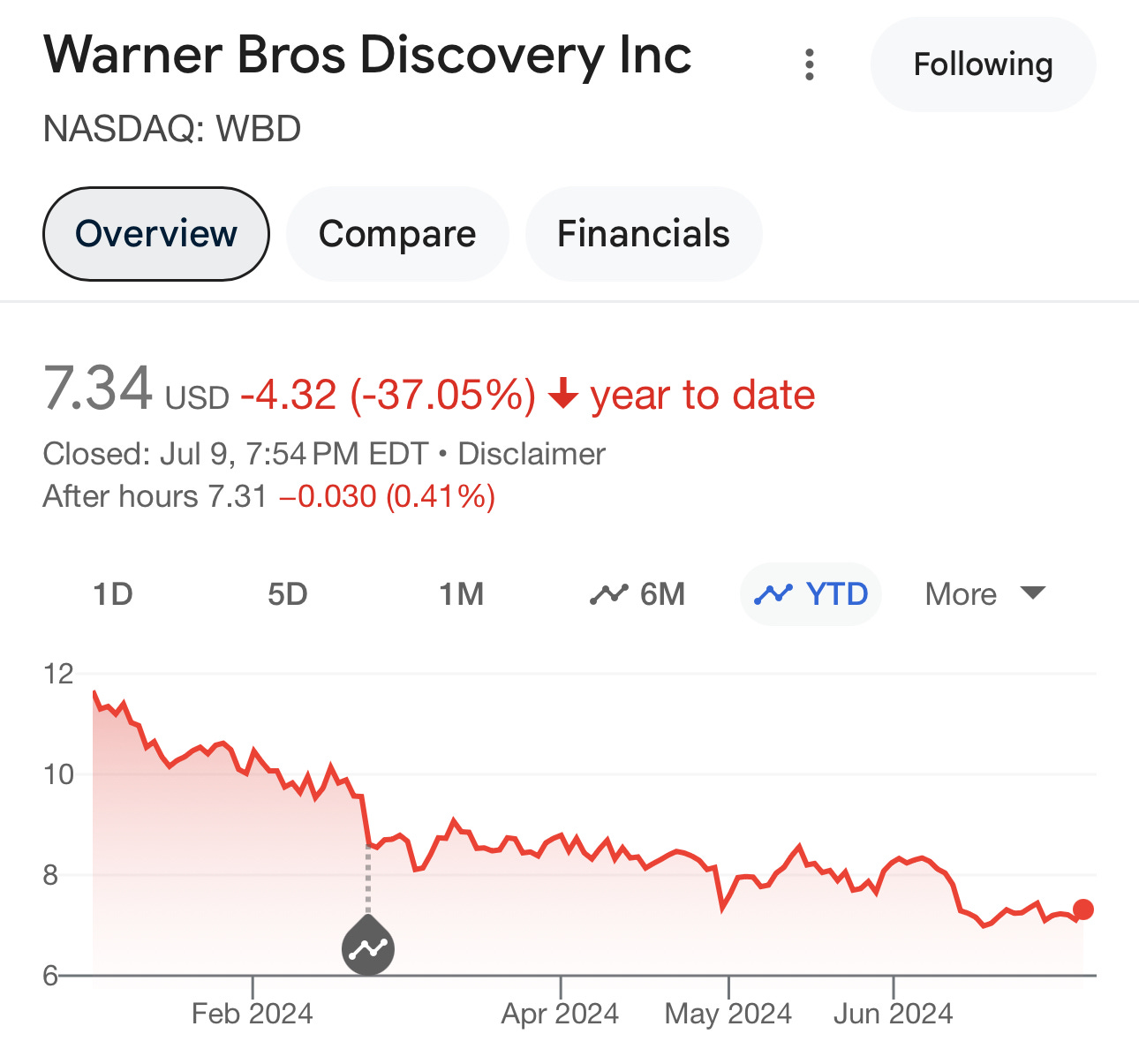
I think everyone may have gathered that I am sympathetic to WBD’s general plans. However, it is fair to say that they may have overestimated the customer love achieved by combining HBO, Discovery, the cable nets, and CNN. Also, they may have overestimated Wall Street’s enthusiasm for the plan of paying down the debt and driving to modestly positive free cash flow. I do not think that investors actually want to hear that Max is flirting with profitability while it doesn’t grow and the movie studio does not grow and the cable networks shrink. What the market wants to hear is that the streaming service is going to be a big winner. And regardless of what Wall Street thinks, their quarterly expectations simply cannot be the determinant of WBD’s strategy. Max must grow and it’s a great service but it needs more original programming to keep customers and grow. When I finish Curb or House of Dragons there has to be something else to catch me. Max has great leaders but needs more ammo — at least a $billion a year. This is not the year to break even. It is time to invest in growth.
From a psychology point of view, I know some people will hate this but, everything at the company has to be oriented around Max. We don’t sell a product called “Warner Bros.” I saw an Instagram of a friend the other day taking a tour of Warner Bros and wearing a Warner Bros t-shirt — but where are the Max t-shirts? Can you go home and subscribe to “Warner Bros”? Every email in the company should be @max.com. The water tower should say Max. The stock ticker should be MAX. Everyone’s first son should be named Max. Why? Because Max is the name of the f*^%#?!n product we sell! It is literally what is sold by the company. Do you know what the Coca-Cola Company is called? It’s called the Coca-Cola Company because that’s the product — cola filled to the brim with literal cocaine. (Ahh, if only that were our product.) In any case, focus.
I know a lot of good stuff is coming, like a Harry Potter series and more international expansion, but I think cash flow has to go down for the next year or two as another billion or so is pumped into original content at Max. And the idea of merging with Paramount was of course good. It still is, though it might be more doubtful now. (Hard to say for sure.) Bundling will reduce churn but also — I think — reduce the realized pocket price of the service. Will that be enough in itself? Let’s see.
What they should do: pump up the volume
What they will do: I’m guessing, but probably stay the course and bundle
DISNEY
Disney has a royal flush of brands but of late has exhibited creative inconsistency and seems to have a very low tech IQ. Even their in app merchandising is horrible.
Wrt tech IQ, this is a good example of a company where I would like to see a more visible and senior technical leader. There is plenty for the person to do.
Creatively, Pixar, Disney Animation, Marvel and Lucasfilm have all fallen on hard or very inconsistent times at the same time (coincidence?) and Lucasfilm has simply become the place franchises go to die. (Can you imagine how big Star Wars could have been?? Oh, well!)
Meanwhile, their app experience is not good and they aren’t innovating at all in terms of experience.
I feel like Disney has an amazing team if we were time traveling back to the year 2000. If you had infinite money, name one person you’d poach from the Disney team. Maybe Kevin Feige? But is this going to be the old Kevin Feige or She-Hulk Kevin Feige? Ok Pete Docter but that’s cheating because technically he’s talent.
Disney is pretty well off anyway and now, with Hulu and ESPN and ABC, can make a formidable claim to having not only a clear brand (thanks, Walt!) but also enough breadth to hope to be the first app you open on Roku. If they can pull themselves together creatively, they would be able to turn Disney+ into the huge winner it wants to be and really get on track.
What they should do: Use CEO succession as an opportunity to clean house. There is something wrong with the culture. Lucasfilm needs a total revamp but in general the personnel policy needs to be a Stalin-esque purge.
What they will do: Choose an ancien regime CEO and continue to be inconsistent creatively and lag in technology. But their brands and sequels and array of assets will keep them going for a while.
PARAMOUNT
What an exciting time. A new, well-financed, tech friendly team. My favorite. Mostly, people think that Paramount is subscale and must merge. I like some of those merger scenarios but I’ve said before I think they can make it on their own if they focus their brand on things people love but Hollywood isn’t doing well (like comedy for starters). The one thing they cannot do (and hopefully the new infusion of capital will allow them to not do this) is to cut back on the service and try to eke out a profit on a cut down service. Their brand opportunity is South Park/Yellowstone/Mission Impossible/CBS. They’ve already got this. As the oracle said, Know Thyself.
Meanwhile, Paramount, like others, has millions of users with apps installed on phones. How can we make that drive more frequent visits? How can we drive more valuable notifications? Can we deliver social features and more daily programming? I’d be eager to see experimentation and innovation here looking at metrics like visit frequency and time per visit. This will cut down on churn and differentiate from the industry. If all of the innovation is b2b (ad tech) that’s a mistake.
There is no question the movie department has to pump up the volume, including making (gasp!) originals. And can anyone (a) name a great new show from Paramount that wasn’t from Taylor Sheridan and (b) tell me who is actually the head of programming? Those two questions need to be easy to answer. Streaming and movies have to be one department and they have to figure out the brand and get aggressive about it. Fortunately, the brand is sitting right there ready to go.
One thing that has to be examined is the deal with Wal-Mart. Paramount has a high number of subscribers, a low Average Revenue per Subscriber (ARPU) and low viewership. This has never made sense to me. Is it a consequence of the Wal-Mart deal?
I would still take a look at what the WBD merger terms might be. There are real synergies between the two companies. However, what I have heard is that the idea might be to just enter into some sort of JV or just sell Paramount+ to WBD. That sounds like a very complicated deal! How is the deal affected if Paramount sells Nickelodeon? How is it affected if Paramount movies underperform? Is it a fixed price license or is it entirely variable and performance based? Who controls merchandising and promotion of the content? What happens at the end of the term if it is not a sale? Does Paramount have to restart Paramount+ as a freestanding entity? Yikes. I would worry about litigation — but I would not rule it out. It could also make sense to look at Lionsgate, newly free of Starz.
And one more thing — I would not ignore international, as many are doing. There are ways to accelerate progress there.
Exciting times.
What they should do: Focus the brand. Make more movies. Win on experience.
What they will do: Too early to say. They might do that!
AMAZON
Amazon is a special player in subscription video because it is tied to Prime. I’d say they are pushing toward a clear brand with the NFL, sports docs, Fallout, Warhammer (on its way), Terminal List, The Boys, Reacher, Citadel (I guess) and Rings of Power (I suppose). Netflix skews F30-54 + tweens and Amazon is obviously looking at a male skew to counter-program, which makes sense. Amazon is also the leader in transactional video on demand, and the Amazon Channels program consolidates a lot of industry demand onto the Amazon platform, which helps drive visit frequency. Churn is low because it is part of Prime. Pretty fantastic.
The only problem at Amazon is that their actual series development has not been good. I’m not saying this out of personal feelings — I swear! — but really Reacher and Fallout are the two very successful shows that have been developed in the past 6.5 years. You can google the details, as they have been extensively analyzed, but Rings and Citadel, whether you look at IMDb scores or percent of viewers who finished the seasons, were not well received. I don’t know what to say. Having two standout shows in six years is just way below the bar and is below every other network on this list. (Not to mention that Amazon has struck out now at awards shows for years, which must be beyond embarrassing. What do you talk about at Amazon Emmy parties??)
I like everything about the Amazon strategy but of course you don’t want to be too gender skewed as a large scale service (especially a retail service) and clearly the series need to be better. In the old days, a change would be made. I think the reality now is that, for political reasons, a change can’t be made. It is what it is.
What they should do: Substantially improve series development.
What they will do: Keep on keepin’ on.

APPLE
No one in the industry can quite figure out what Apple is doing with Apple TV. They seem to be emulating a sort of earlier version of HBO but their volume is not high and they don’t have a library. They do some good shows. I liked Palm Royale. Obviously Ted Lasso won Emmys. But it’s strictly appointment television. You’re rarely going to open the Apple app first just to see what’s on. Which matters because it’s not like the old days where you might be changing channels and happen upon Showtime or see it on the grid. In on demand, you either choose to open the app or all of its programming is completely invisible to you. I feel like this is some sort of bookmark for Apple to decide whether it wants to do something in this space one day. Meanwhile, the expense is not significant to Apple so they might just keep things as they are. But, if not, they could go big and acquire someone or they could shut it all down. If I were Apple, I don’t think I would acquire a major entertainment company and if they were interested in that, why were they not players in the Paramount drama? They understand their own business and they do not understand Hollywood and it would be a huge distraction without commensurate upside. How many stockholders would vote for Tim Cook to spend 10% of his time on showbiz? None. Yes obviously I advocated for Amazon to get into showbiz but the upside for Amazon was much greater than for Apple (and it worked out for Amazon).
What they should do: Honestly, I’d probably shut Apple TV down and just do TVOD and a sort of Amazon Channels offering.
What they will do: I have no idea but if they acquired a studio I’d be very surprised.
COMCAST
Comcast sells bandwidth. I understand why they bought NBCU at the time but I am not sure why they still need it. It seems like a distraction and they barely discuss it on their quarterly earnings calls. Peacock is subscale. If I were Comcast I would jettison NBCU as a whole and focus. The outcome of Peacock is irrelevant to Comcast’s overall business. Just merge it with WBD.
INDIES
Part of the problem with the indie sector is that every studio and every streamer has a small slice of the indie business. Therefore, if you like indie films and want to stay up with the sector, you would have to subscribe to every service to stay up to date. This really dilutes the ability of indie to gain any kind of critical mass and momentum. Meanwhile, these major studio indie labels like Focus and Searchlight are more or less hobby horses that are off brand for their parent companies.
What should happen is that Searchlight, Focus, Neon and/or A24 (or in any case some group of indie players), should be spun out and merge and launch the definitive indie streamer. Add 18 original series per year and I think you’d have 30+ MM US subs and an international sub base. It would be both a good business and great for specialty film.
This is complex to put together and frankly is unlikely. But, for example, Searchlight would create more value as part of this NewCo than it does sitting inside of Disney. So it makes sense. But not everything that makes sense happens. You could also try to build this from scratch, but on your way up you’d be competing against all of these indie players, which would be tough.
Actually, if Apple did want to make a move in directly participating in showbiz in a way that is aligned with the brand they have already built, this would be the least crazy approach.
WILD CARDS
YouTube is huge.
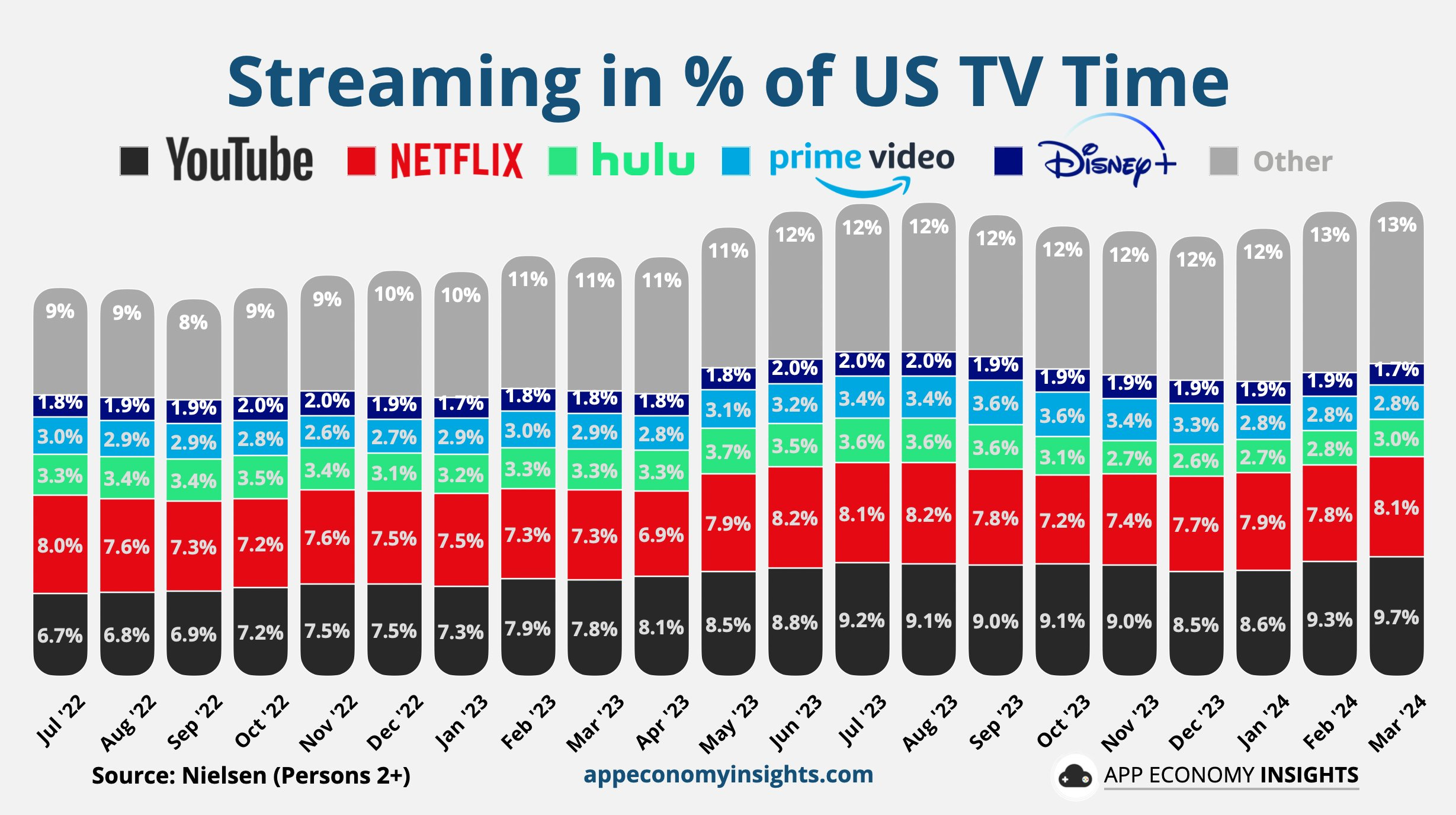
Often people don’t think about them in the same context as Disney and Netflix but they are a big part of the video business and they have infinite money. Do they want to get into subscription beyond YouTube Premium? They certainly could.
In addition, Wal-Mart is out there. Premium video certainly works in the context of a retail subscription model. Right now, Wal-Mart relies on Paramount+. But is that a permanent arrangement?
And finally, imagine if AI gets a lot better and the cost of delivering a new series drops by 99%. Or even 80%. This would mean that creators could make their own series and pop them on YouTube or some new platform optimized for this purpose. Is that the future? That does not sound appealing in a way, but I’ll tell you this. There is no way that AI is going to be irrelevant.
We began by noting the changing of the guard in Hollywood. Looking another 30 years ahead to 2054, who will be in the industry power photo then? Tech visionaries merging Silicon Valley with storytelling? Streaming executives who've cracked profitability? AI-empowered creator-entrepreneurs?
The path there will be paved by those who build strong, consistent brands, field the best teams, and continually evolve in a changing technical and global cultural environment. They'll navigate AI, enhancing rather than replacing human creativity, and have the courage to invest in growth.
Wild cards like YouTube, Walmart, and AI ensure an unpredictable journey. Those who navigate it successfully will write Hollywood's next chapter - and give the speeches at that 2054 gala. (And maybe then they’ll run for President!)
Stay tuned!
Roy Price was an executive at Amazon.com for 13 years, where he founded Amazon Video and Studios. He developed 16 patented technologies. His shows have won 14 Best Series Emmys and Globes. He was formerly at McKinsey & Co. and The Walt Disney Co. He graduated from Harvard College in 1989.
Probability of Netflix changing anything internally along with other consolidating SVOD divisions until court mandated like the recent Epic Games Vs Google victory under different developer competition law arguments = low
Probability with incentives to get more global action from cinema and limited series markets to keep up with the Netflix enterprise model if it’s shown to be able to be brokered with global pre sales and guaranteed minimums distributing risk = high
More specificity in modeling with cinema versus limited series in particular (thinking of Shoguns renewal on FX after its success after it was billed as a). Kevin Costner’s Horizon : An American Saga while it flopped in the theaters and is being reported to possibly being pulled from theatrical given it was a wholly independently financed project with some of his own money there still is not a lot of curated analysis on mid budget formulas in particular whether it’s micro budget sub $3M like 2014’s What We Do In The Shadows that later sold to FX or $100 M plus like Horizon (I still suspect to be wildly excessive). Studios like . . . Lions Gate per instance if they want to keep up with Netflix need to be able to license to them to exploit across seeding the I.P. while we license them our rights in kind. What’s it look like at scale as an asset class , what are the competitive threats and conflicts of interest with incentives , what is the fiscal reality versus incumbent executive management control practices