

It has been my impression that movies have substantially declined in quality over the past seven years or so, and I decided to see whether this could be observed in the numbers. The results are interesting.
First I looked at how the average IMDb score of films that won their opening weekend varied between 2018-2019 and 2024-2025 (counting only through September 23). My instinct of course was that we would see a decline. And, in fact, we do see a decline. The average movie that won its opening weekend in the earlier period had an imdb score of 6.77. The average winner from 2024-2025 had an imdb score of 6.64. This is a difference of 0.13, which is more notable than it may at first seem because IMDb scores generally only range from ~6.0 to ~8.0.
My instinct was directionally correct, but the difference was not very dramatic. Maybe I am just being a nattering nabob of negativism, as Spiro Agnew once said.
Then I asked: of these films that had won their weekend, what percent had a score of at least 7? In 2018-19, 38.1% of the movies that won their weekend received an IMDb score of 7 or above. In 2024-2025, that number was 35.2%. (If we set the filter to IMDb = 8.0+, the numbers are 7.9% and 5.6% respectively, which is about a ⅓ drop). Again, things do appear to have gone in the expected (not good) direction but maybe not in a life changing way.
I decided, looking at this data, that I might not be asking the right question at all. That is, how people feel about the biggest blockbusters may be quite different from how people feel about films in general. So I decided to see how many films received an IMDb rating of 8.0 or more in these years (with the qualifier that they had to have made at least $5MM at the US box office). Here we saw a more dramatic shift:
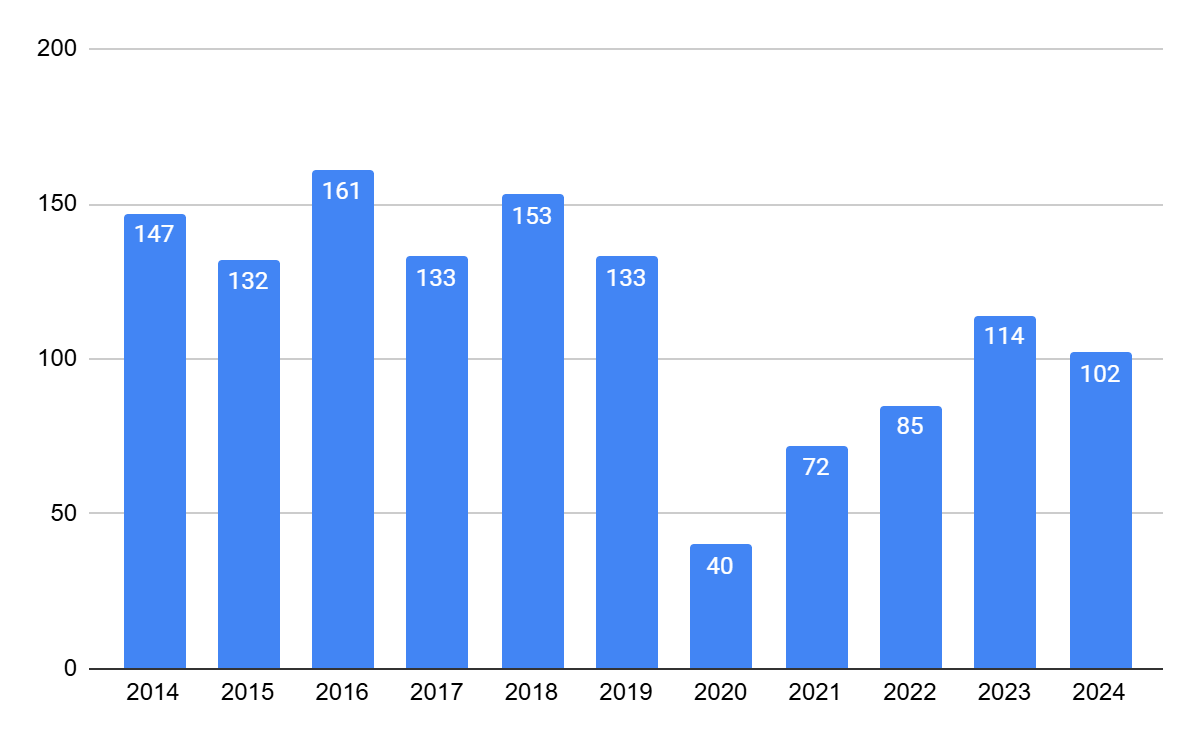
So we are down from an average of 143 from 2014-2019 to 102 last year (and 64 so far this year). That’s a 29% decline from the 2014-2019 average to last year’s number. That accords with my subjective impression much better.
It is also interesting that the decline, when measured in this way, is also approximately one third, which correlates to the decline in 8+films at the top of the box office heap (29%).
Then the question becomes: are there fewer truly outstanding movies being made or do we have the same number of great movies except that many of them (perhaps 29%?) are going straight to streaming?
That is more difficult to answer. But I suppose I would ask – do you think there were 40 really excellent films released straight to streaming last year? If you do, then I am obviously watching the wrong streaming networks! I think the number is nowhere near 40. So while I think the decline in very well regarded films can be partly explained by the straight to streaming trend, I very much doubt that accounts for more than half of the observed decline.
How should we interpret this, noting that we have looked at similar numbers in television over similar periods (here)?
I do not think it would be correct to speculate that customers’ appetite for extraordinary films has substantially waned. Why would we believe that?
Or perhaps customers have become more difficult graders on IMDb over the past few years? But why would that be?
Or perhaps the creative members of our society have suddenly become substantially less creative? Again, you never know but that seems unlikely to me.
Bear in mind, these films are not all My Dinner With Andre. There is no upper box office limit on this 8+filter. Avengers: Infinity War! is on the list.
If we have not changed the pipeline of high potential films, and you have the same or a substantially similar pool of talented creators, then why would there be noticeably fewer 8+ films?
You might be saying “it’s the number of films, stupid!” — we make fewer films so there are fewer great films! But wouldn’t you think that the system would tend to prefer more outstanding films and disproportionately choose to make those? That is, if you reduced the number of films you were going to produce overall, do you suppose that you would cut the list down at random? Or would you try to release the best ones? Or do you really have no idea which the best ones are?
It is hard for me not to conclude that we have some sort of executiving problem but here are all the possibilities:
The executives are not as good or aren’t getting equally good training.
The execs are just as good but they have too many rules and distractions. (This I would believe.)
There is a misalignment between Hollywood and the people.
It’s harder to launch a star in this social media age, so we don’t have the stars especially younger stars who could launch some of these films. (Maybe? But we do have some younger stars.)
Whoever would have been the “Francis Ford Coppola of today” is off writing some substack or trying to be an influencer. Or they work at Google. (Possible but unfortunate because there is less we could do to correct this.)
Have to admit, I am not sure what the answer is. But if our great movies are down by a third, we must investigate and figure it out.1 In the meantime, I think there is room for 20-40 more movies on the market.
Oh, one last thing:
All the best,
Roy Price
A note on IMDb. Some people don’t think it is useful or that it signifies much, but I have found that it does a good job predicting views on streaming so it is certainly measuring something. I do have misgivings about the fact the Lost in Translation is only a 7.7 but there is no accounting for taste. Plus — what else do we have?
It's the misalignment between Hollywood and the people. I have a degree in critical theory, which forms the basis of cultural production today. Movies were popular when they touched the humanity of the viewer with classic stories of redemption, heroism, conflict, love. Movies should go back to storytelling. Godzilla is more than a creation of our nuclear bomb, he's the monster inside us. And the original Snow White and the recent SW illustrate the old adage, if you want to send a message call Western Union.
Excellent analysis.
In a business sector where most people have opinions on every subject, it is refreshing to see that some analysts ask interesting questions.
Like it or not, investors respond favorably to "the smartest guy in the room."
Roy Price continues to share very valuable information that can benefit independent film producers, studio executives, and other players.
Prediction: Those who use his research, analysis, and insights will be more successful than those who don't.